Cosmillion looks like a trivia game and plays like a bet against everyone else. Every prompt has a thousand valid answers; the game pays you for picking the one the rest of the world did not.
The rules in one paragraph
Each day Cosmillion gives you seven prompts. All seven are the same for everyone playing that day, and each one gets 25 seconds on the clock. You type one answer per prompt. If it fits, you score points based on how rare it turned out to be among that day's players. After the seventh prompt your rocket stops, your altitude is your score, and the launch is logged for the day.
Cosmillion controls on desktop and phone
Desktop. Click the answer box, type, then send with Enter or the Launch button. The player has its own full-screen button in the corner; use it when the prompt and the clock feel cramped inside the frame.
Phone and tablet. Tap the answer box to raise the keyboard, type, then tap Launch to send. The keyboard covers the lower half of the frame, so full screen is the calmer way to play on a phone, and landscape gives the prompt and the countdown more room.
Before you send. One answer per prompt. If the game offers a corrected spelling when you submit, accept it instead of retyping — the clock is still running while you fix letters.
After the seventh prompt. Your altitude is your score and the launch is logged. The result can be shared from inside the game, and the streak carries into tomorrow.
What counts as an answer
A valid answer is a thing that genuinely belongs in the category the prompt asks for. The game is generous about spelling — a typo does not cost you the answer — but it is not generous about interpretation. If the prompt asks for a fruit and you send a vegetable that people argue about, you have gambled a prompt.
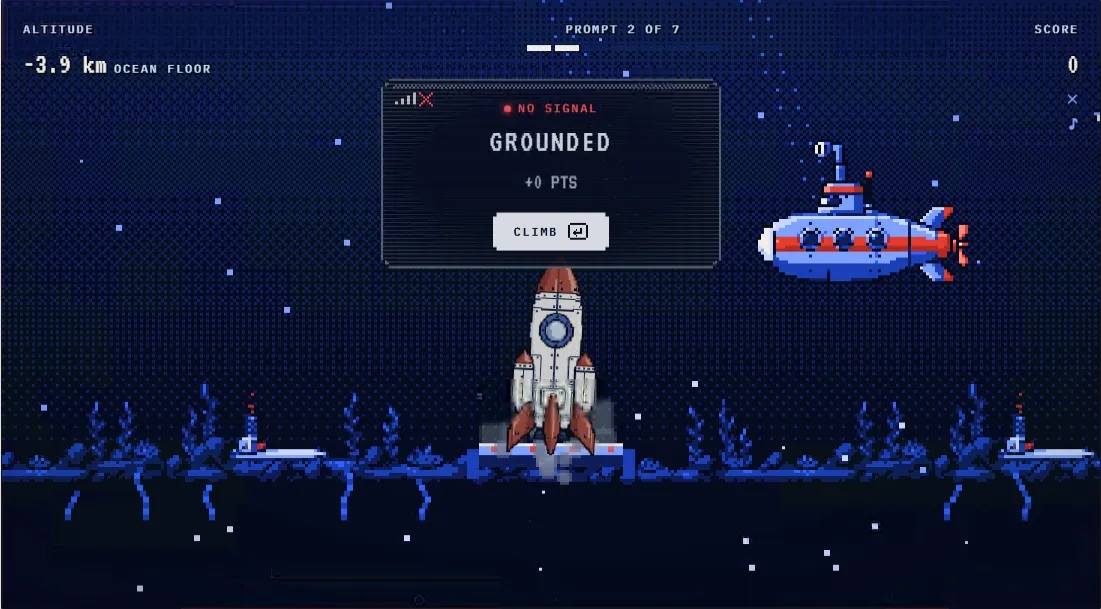
A prompt that ends with nothing accepted pays nothing: the result reads No Signal, Grounded, +0 PTS. The prompt is spent either way, which is why a weak guess still beats an empty box.
How each rank is decided
Cosmillion does not publish its cut-offs, and no outside page can tell you the exact numbers. A rank is a statement about how many of that day's players sent the same answer, which has two consequences worth knowing before you play.
- The bands move. A word that lands in Deep Space on a quiet Saturday can fall to Cadet on a busy Tuesday, because the crowd it is measured against is different.
- You are being compared, not graded. Nothing you send is wrong as long as it fits the prompt. It is only common.
What is fixed is the scale itself:
- Tourist — +10. Everyone packed that one.
- Overthought — +15. It felt clever, but the whole crew found it too.
- Cadet — +30. Solid, flying with the squadron.
- Astronaut — +60. Genuinely uncommon.
- Deep Space — +85. Almost nobody went there.
- One in a Galaxy — +100. The rarest answer on the board.
Seven prompts at the top band come to 700 points, which is the ceiling. A full round of obvious answers comes to 70.
Spelling, typos and what still gets scored
The line the game repeats on its own front page is "spelling is forgiven, guessing is not". In practice the letters are not what you are being judged on: a rare answer typed with a missing vowel still counts as that rare answer, while a perfectly spelled word that does not fit the prompt earns nothing. So spend the twenty-five seconds on rarity, not on proofreading — and never send a word from the wrong category just because it is easy to spell.
A worked round, prompt by prompt
The game's own front page gives the example that explains everything: on the prompt "Name a fruit", Apple is worth +10 and Jabuticaba is worth +100. Same prompt, same twenty-five seconds, ten times the points.
Here is an illustrative round (not a real scoreboard) where every prompt gets the answer that arrives first:
- Name a fruit — Apple → +10
- Name a country — France → +10
- Name a colour — Blue → +10
- Name something cold — Ice → +10
- Name a musical instrument — Guitar → +10
- Name an animal — Dog → +10
- Name a vegetable — Romanesco → +85
That round comes to 145 out of 700: six answers that anyone could have sent, and one that carried more weight than the other six together. Swap even three of the obvious ones for rarer answers and you are past 350. That spread is the whole game — which is why a 400 is worth talking about and a 70 is just a well-spelled shrug.
Beyond the daily launch: how the four modes differ
Beside the daily seven, the game shows four more entry points. They are not four copies of the daily round:
- The archive keeps past days, so a missed launch is not lost and a new player can practise on yesterday's prompts. Practising there does not touch your streak, because only the daily launch is logged. Whether any of it has to be unlocked is decided inside the game, not here.
- Themed packs are extra rounds grouped around one theme — for when the seven prompts end sooner than you would like.
- Unlimited keeps the prompts coming without the once-a-day limit, which makes it the mode to use when you want to test whether your instincts are actually rare.
- The logbook is the record: your launches and your altitude over time. It is where a streak becomes visible.
The daily launch is the round that counts for your streak, and it is the free one. The official site does not say what the other four include or whether anything has to be unlocked, so this page does not promise they are free — check inside the game.
How to raise your altitude
- Reject your first answer. Say it, then set it aside. If it arrived in two seconds, so did everyone else's.
- Go one level narrower. A fruit is crowded; a fruit almost nobody eats is worth a hundred.
- Do not fix typos. The clock is 25 seconds and spelling is forgiven. Spend the seconds on rarity, not on correctness of letters.
- Save your best categories. Instruments, fabrics, weather, regional dishes, obscure sports — these are the thin rooms. Countries, colours and animals are the crowded ones.
- Practise wherever the game lets you. You only get one logged launch a day, so use whatever practice the game opens up — the archive if it is available to you, unlimited rounds if it is not — to test whether your instincts are actually rare.
Four mistakes that cost points
- Typing the word the prompt suggests. Prompts are written to invite the popular answer.
- Treating it like a quiz. There is no right answer to find, only a rarer one to invent.
- Burning the clock on spelling. See above.
- Skipping a prompt you cannot solve. Every prompt is scored, and a weak guess still beats nothing at all.
Ready to launch?
The game loads in the frame on our home page, so you can start without leaving the site. Play Cosmillion and see what your first instinct is worth.